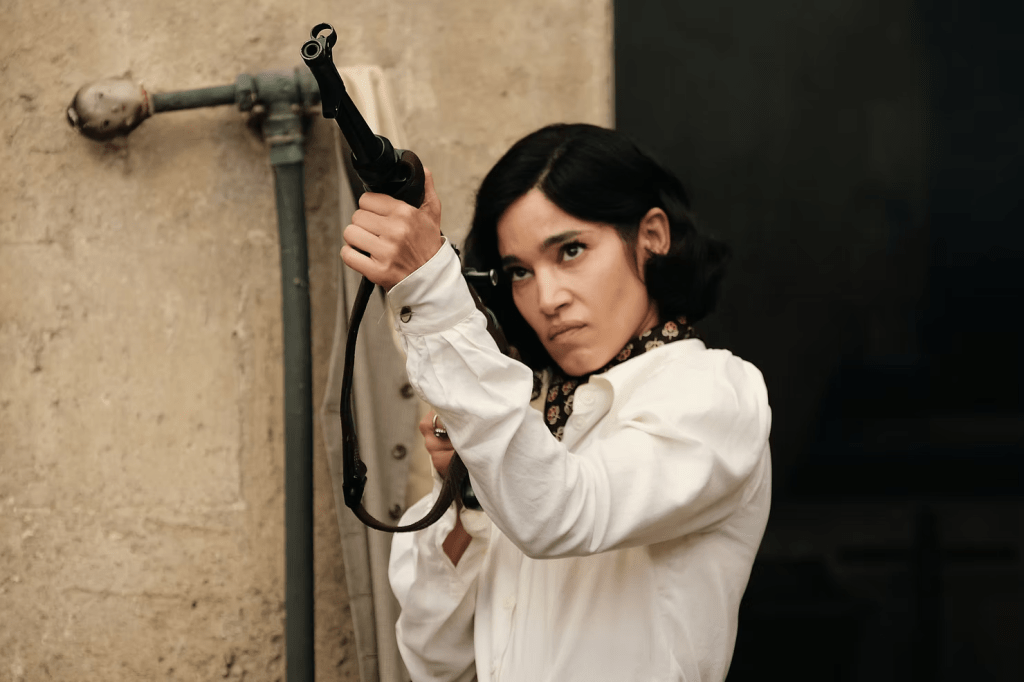
Sofia Boutella as Eve Mansour in BBC One series SAS: Rogue Heroes
“This is not a history lesson”, appears in the opening of all 12 episodes of BBC One’s SAS: Rogue Heroes. As an avid fan of both the books and the show, the historical inaccuracies of the screen adaptation do not offend me. In fact, the creation of the character of Eve Mansour, to help offset the overwhelming masculinity in the 1940s North African desert in the show’s first season, was a welcome addition. However, Mansour’s character progression in the second season, which aired in January 2025, got me thinking. Real women participated during the Second World War, so what about them?
The second season does, in fact, feature two female Italian resistance fighters; the fate of one is unknown, and the other, who goes by the (fictionalised) name Alessia Bondi, was largely characterised both through her relationship with Sergeant Pat Riley and the jealousy this stirred within her fellow resistance fighter, Alfredo. All of which concludes with her rather unceremonious off-screen execution.
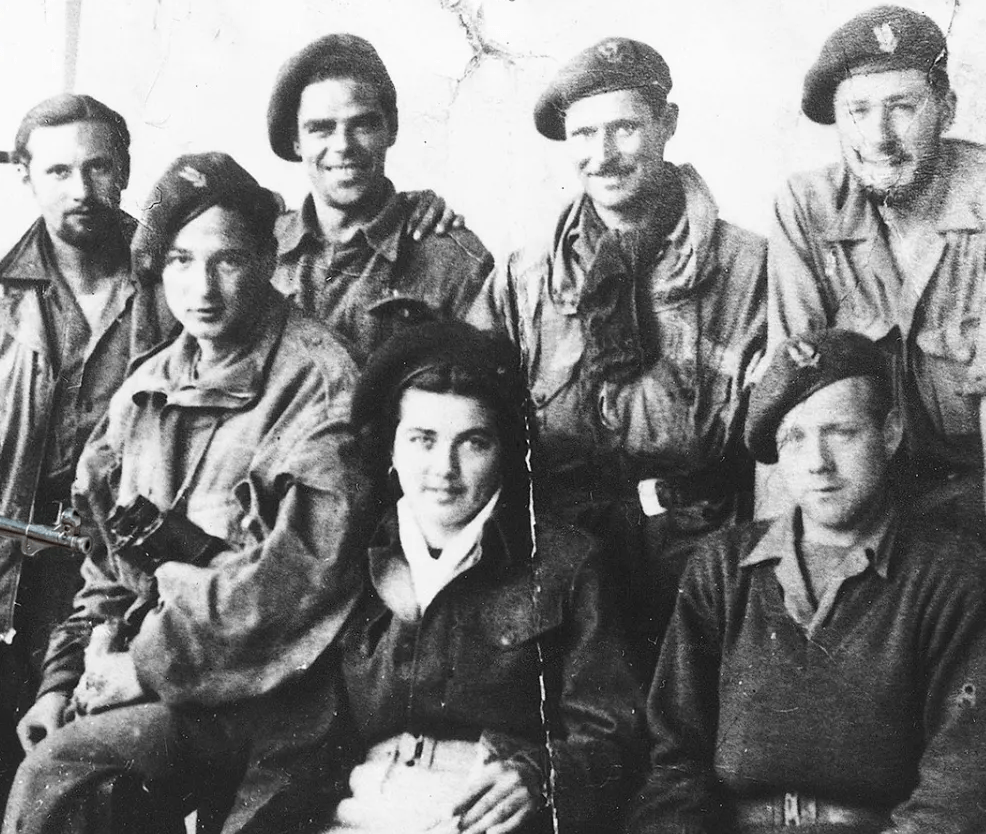
Female Italian Resistance Fighter, known as Norris pictured with members of the SAS
An article written by author Ben Macintyre for The Times, Women fought with the war’s rogue heroes, does in fact go into some detail about those female resistance fighters who fought alongside the SAS.
As seen in the show, Italian partisans played a crucial role in the liberation of Italy, with female fighters participating not only in armed resistance but also in intelligence gathering. The only known name of a female resistance fighter who fought alongside the SAS, was a women who went by the codename Norris. She was the leader of a female partisan group who gathered information and participated in combat. Known for her ferociousness and ability to flirt with German soldiers for information, Norris perhaps bares a striking resemblance to the fictionalised Eve Mansour.
Whilst season two’s six-episode scope may be the reason why the character development of Alessia Bondi is limited, her time on screen could have potentially been utilised to showcase more of the spirit and fearlessness of Italian partisans, rather than perpetuating a narrative where female agency remains secondary to masculine exploits and rivalries.
In his article for The Times, Ben Macintyre, writer of SAS: Rogue Heroes and executive producer of the show, stated that Eve Mansour is a character intended to honour the female agents of the era. How many of these resistance fighters dressed up as Nuns to visit and bed a British Lieutenant-Colonel in a prisoner-of-war camp is a number I am unsure of (I doubt there were very many, if any at all).
Whilst it is clear that Eve Mansour lacks the aesthetic wartime practicality most women adhered to at the time, her most notable feature throughout both seasons remains her striking red stiletto nails. Whilst I imagine Eve’s nails are supposed to be natural, seeing as acrylic nails were only invented in 1957 by dentist Frederick Slack. Eve’s nails remain but one factor among a litany that, to me, clearly marks her as a twenty-first-century creation, far from the women both Macintyre and Boutella believe Eve to be a reflection of.
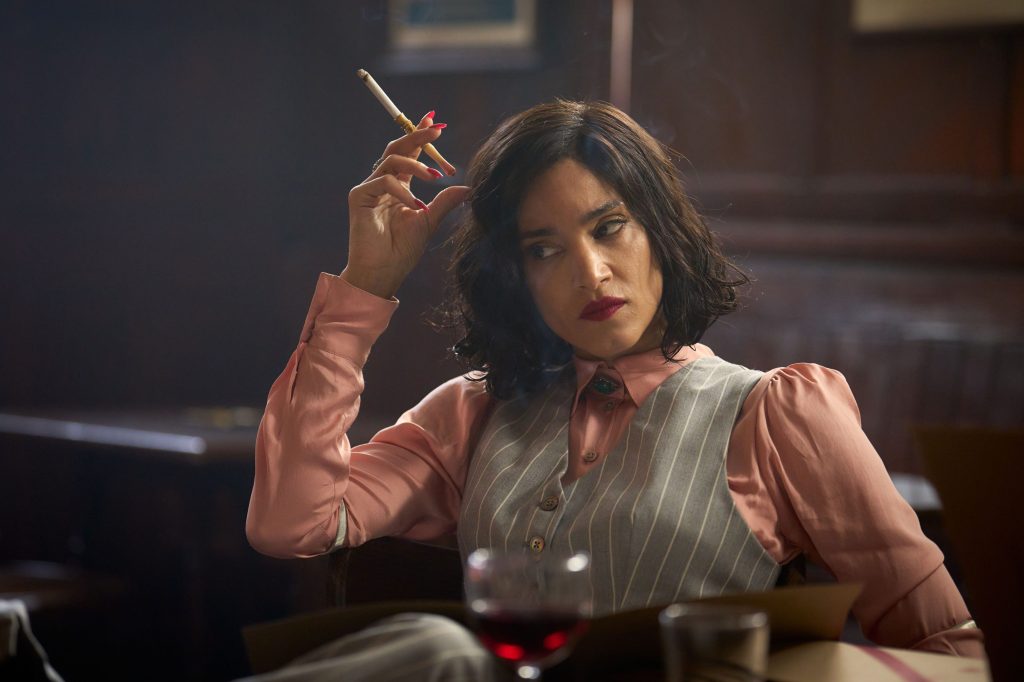
Sofia Boutella as Eve Mansour in BBC One series SAS: Rogue Heroes
In an interview with MEDIASHOTZ, Sofia Boutella, who plays Eve, endorses Macintyre’s point. She affirms that, while Eve is a fictional character, she is very much inspired by female spies of the time, drawing comparisons to Noor Inayat Khan and Virginia Hall.
Virginia Hall
Of the two, I am less knowledgeable about the war work of Virginia Hall. American-born Virginia Hall was one of the first female Special Operations Executive (SOE) agents sent to France. As the founder of the circuit ‘Heckler’, she took unkindly to the arrival of a male SOE agent sent to ‘supervise’ her. As one of the longest serving SOE agents in the field and a mastermind behind the Mauzac prison break, Hall’s bravado is perhaps more akin to the essence of Eve Mansour.
In November 1941, with an increasing German presence in France and her cover blown, Hall, disabled since childhood, escaped on foot across the Pyrenees to Spain. Despite nearly dying from the journey and a stint in a Spanish jail for lacking proper papers, she managed to communicate covertly with Allied agents and ultimately returned to England.
After the US entry into the war in 1941, Hall joined the Office of Strategic Services (OSS) and returned to France. Surprisingly similar to the work of the SAS in North Africa, Hall organised missions to destroy bridges, train lines and communications.
Unlike Noor, Hall survived the war, going on to work for the Central Intelligence Agency (CIA). Her time with the CIA was punctuated by sexual discrimination. In her work A Woman of No Importance: The Untold Story of Virginia Hall, WWII’s Most Dangerous Spy, Sonia Purnell states that Hall’s male colleagues felt threatened by her war exploits, and it meant that in her time with the CIA, her experiences were never properly utilised.
Perhaps as a result of this treatment, Hall spoke little of her time with the SOE and OSS during the Second World War, with interest in her work only growing following her death in 1982.
Noor Inayat Khan
My volunteer work with the Commonwealth War Graves has meant that I am well acquainted with Noor and her WWII heroics. I can attest to the fact that Noor did not survive a plane crash over the Desert, nor did she fight alongside the SRS in Tremoli, gunning down members of the 16th Panzer Division. In reality, raised as a Sufi, Noor stayed true to their principles of non-violence. As the first female wireless operator sent from the UK to France, her job consisted entirely of encoding and decoding messages and sending vital intelligence to Allied forces.
Among the stories I share as a tour guide, there are two that nearly reduce me to tears; Noor’s is one of them. She defied all odds, disproving the view of her seniors that she was not best suited to war work, and for three months, she did the work of six wireless operators as the last radio link between London and Paris, all while evading capture by the Gestapo.
Refusing to leave her post until a replacement was sent, Noor was captured just two days before her intended departure. Imprisoned in solitude for 10 months at Pforzheim prison, she was regularly beaten and interrogated, yet still did not reveal anything about her circuit.
Following her transportation to Dachau Concentration Camp, Noor was executed on the 13th of September 1944 at just 30 years old. Her last words were “Liberté”, and in 1946, she was awarded the Croix de Guerre and the George Cross three years later in 1949.
Noor Inayat Khan is commemorated on Panel 243 at the Runnymede Air Forces Memorial.
In no way am I asking Macintyre to haphazardly work in the story of Noor Inayat Khan into the world of SAS: Rogue Heroes; that would entirely defeat the point of the show, and I do not doubt that Boutella’s comments reinforce the idea that Eve was written to pay homage to the work of female WWII spies. However, whilst I understand the intention of Eve Mansour, it is hard not to read her character as a romanticism of the sacrifice of real historical figures.
I hope to reinforce in this blog that historical fictionalisation is a double-edged sword. In the case of Eve Mansour, it introduces the concept of female heroism during the Second World War, but it also risks overshadowing the more nuanced examples of female participation during the war. In this sense, aligning a fictional character like Eve with historical figures such as Noor Inayat Khan illustrates the struggle with reconciling historical fact and heroism with the demands of dramatic tropes.
Eve Mansour succeeds in creating a fierce female character within a narrative field that has long been dominated by masculine heroics. Macintyre and Boutella’s joint claim that Mansour honours female agents of the era feels more symbolic than substantive, especially when measured against the lived experiences of women like Norris, Hall and Inayat Khan.
The show’s nod to women like Norris, through the character of Alessia Bondi, underscores how authentic female narratives could have been featured instead of reduced to a secondary romantic subplot. By comparing the aestheticised experience of war and combat for Eve, with the more nuanced intelligence-based war work of female operatives like Hall and Inayat Khan, SAS: Rogue Heroes risks romanticising sacrifice, instead of a punk-inspired homage to the women who made daring sacrifices during the war just as it is able to do for its male characters.
Find Out More About the Women Spoken About in this Article:
Spy Princess: The Life of Noor Inayat Khan by Shrabani Basu
Noor-un-nisa Inayat Khan: Madeleine by Jean Overton Fuller
Timewatch: The Princess Spy, BBC Two, (2006)
A Woman of No Importance: The Untold Story of Virginia Hall, WWII’s Most Dangerous Spy by Sonia Purnell
Hall of Mirrors: Virginia Hall: America’s Greatest Spy of WWII by Bobbie J. Pogodzinski
History’s Secret Heroes: Series 1, Virginia Hall’s Great Escape, BBC Radio 4, (2023)
A House in the Mountains: The Women Who Liberated Italy from Fascism by Caroline Moorehead
Woman of War: The Italian Assassins, Spies, and Couriers Who Fought the Nazis by Suzanne Cope
Bibliography
Springberg, K. C. 2025. “100 Years of Nail Fashion,” Northern Nail Polish, 21 May <https://northernnailpolish.com/blog/2019/11/28/100-years-of-nail-fashion> [accessed November 1, 2025]
Macintyre, Ben. 2025. “Women Fought with the War’s Rogue Heroes,” The Times, 3 January <https://www.thetimes.com/comment/columnists/article/women-fought-with-the-wars-rogue-heroes-cnnqdn80r> [accessed October 28, 2025]
Johnson, Mark. 2022. “SAS Rogue Heroes: Interview with Sofia Boutella -,” Mediashotz.co.uk, Mediashotz, 7 November <https://mediashotz.co.uk/sas-rogue-heroes-interview-with-sofia-boutella/> [accessed October 28, 2025]
Purnell, Sonia. 2019. A Woman of No Importance: The Untold Story of Virginia Hall, WWII’s Most Dangerous Spy.
 The Reel vs The Real
Leave a comment