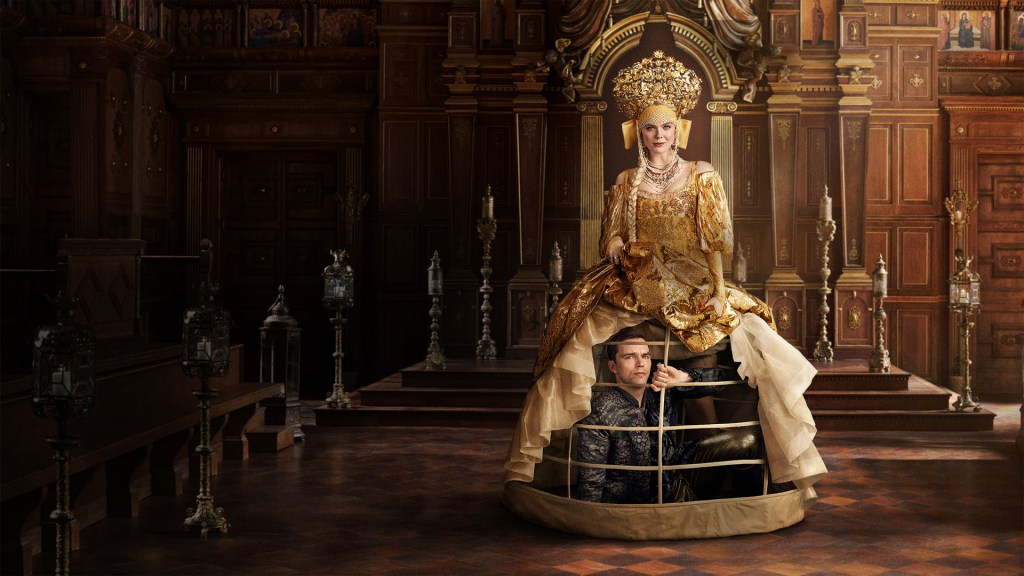
When The Great premiered on Hulu in May 2020, it declared its intentions from the outset: this would be an occasionally true story of Catherine the Great’s rise to power. Fresh from his Oscar nomination for The Favourite, creator Tony McNamara brought his signature brand of historical absurdity to the 18th-century Russian court, promising viewers what The Guardian notes as “an injection of rock’n’roll”1.
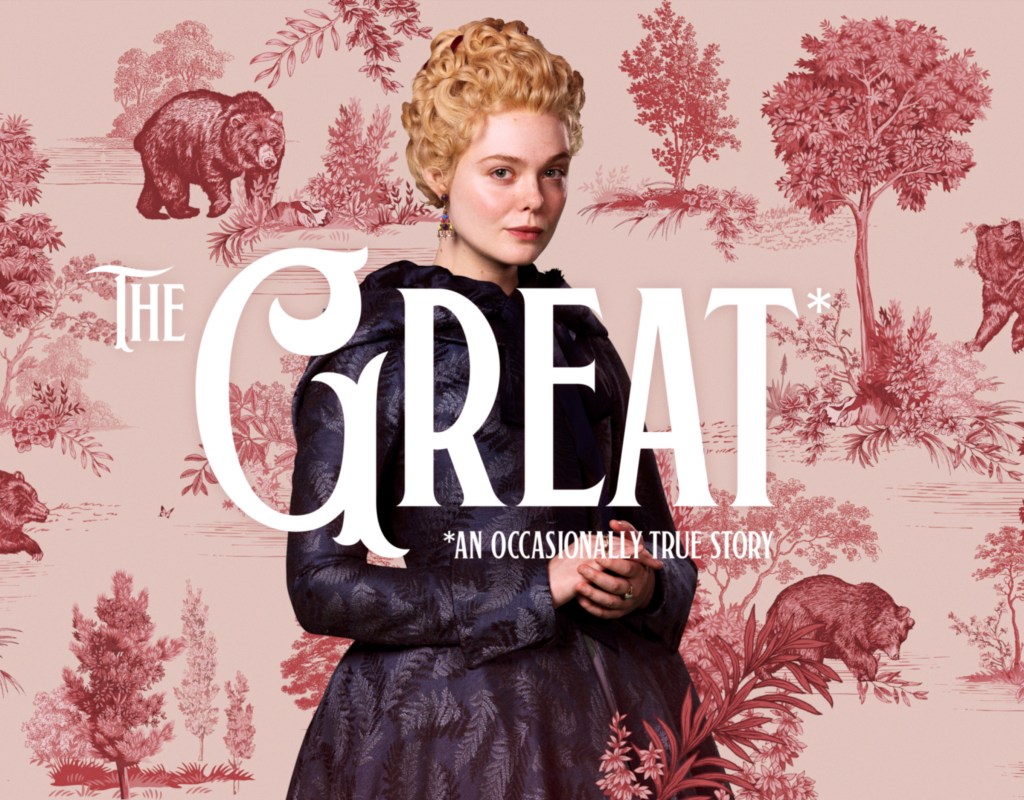
The Great, Season Three, Opening Title. By Darryn Rogers, Suzanne Boccalatte, and Victoria Garcia
*An Occasionally True Story: 32 IS THE NEW 19
Historical inaccuracy in this show is prevalent from the get-go. Perhaps The Great’s most audacious revision appears in its opening scene, McNamara’s Catherine arrives in Russia as a headstrong 19-year-old, “shipped off to a forbidding Russia for marriage”2 The real Catherine, however, was 32 years old in 1761, had been married for fifteen years, and was already a mother of two. This alteration serves a specific dramatic function: it transforms Catherine into a coming-of-age protagonist, in what The Guardian calls a “snappy, vibrant female protagonist for the modern reader”3, who must navigate this foreign court while discovering her own voice. The show’s 26 and a half hour runtime allows for extended character development, but as one critic noted, this length “dilutes the sharpness” that made The Favourite so effective, resulting in uneven pacing and over-the-top farce4.
The age revision could be termed as a ‘millennial makeover’ of historical women. By making Catherine younger, the series taps into contemporary narratives surrounding young women “radicalised by cruelty”, rather than exploring how a mature, experienced political operator actually seized power.5 This erasure of Catherine’s real biography, her years of strategic patience, her network-building, her survival of multiple coup attempts, replaces a complex and often flawed historical actor with a more palatable, accessible heroine for modern streaming audiences.
ROYAL MAYHEM: SUN, SEX AND SUSPICIOUS COURTIERS
The Great revels in its deliberate historical inaccuracies. The series is saturated with swearing, sexual spectacle, animal cruelty and perhaps most inconceivable, feminism. This approach extends McNamara’s vision established in The Favourite. The Russian court becomes a “supremely and unsparingly filmed circus of drunken mirth, public sex, rococo ladies in powdered wigs and unceasing acts of senseless cruelty”6
In a review for Season 3, it’s argued that the 10-hour length grants “license for an aggressive assault on the boundaries of decorum”7. It is not drawn-out displays of royal depravity that matter, but the way the series weaponises historical reality to speak to contemporary concerns.
The show’s profanity and overt sexuality are employed to best exhibit the Russian courts power hungry chaos. The constant profanity, however, obscures the nuanced ways Catherine negotiated her gendered position at a court that was already steeped in ritualised performativity. Contemporary observers, such as James Harris, First Earl of Malmesbury, noted that the Empress possessed a “masculine force of mind”8 yet also displayed “the weaknesses vulgarly attributed to her sex”9, which he lists as “love of flattery, vanity, and a propensity to voluptuousness”10. By collapsing these contradictory tropes into a single modern feminist trope, the series flattens a historically contested identity into a tidy, present-day empowerment narrative.
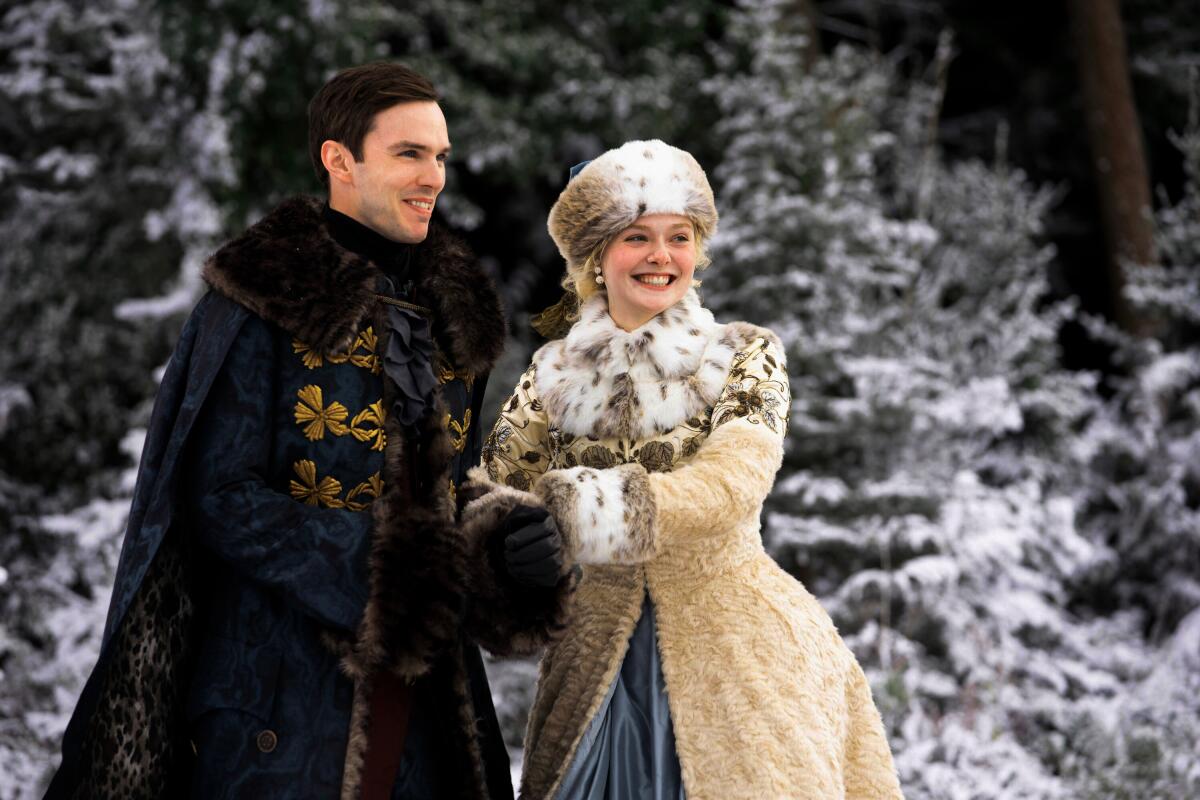
Nicholas Hoult as Peter and Elle Fanning as Catherine the Great, in Season 3 of The Great
LAW IN THE GREAT: DECREES, DIVORCE AND “OCCASIONALLY TRUE” REFORM
Season three, which opens at a relatively stable point in Catherine’s fictionalised rulership, allows for McNamara to delve into the Empress’s legal exploits. The balance of power has “settled: Catherine the iron-fisted administrator of the Russian realm, and Peter the amoral playboy at her side”, while those around them move pieces on an increasingly bloodied chessboard.11 In this “more pragmatic, less ideological era of the revolution”, law is largely reduced to Catherine’s capacity to incapacitate enemies, with Catherine’s ex-servant-best friend, Marial, remarking, “This is all getting very disturbing”12.
The two most notable instances in which Catherine attempts to implement her own enlightened rule of law in The Great are her assembling the 1767 Legislative Commission and her attempt to make divorce possible.
The series captures something real by making legislation feel personal. Catherine’s political endeavours are always framed as extensions of her sense of self: she wants laws because she has read Voltaire, because she is enlightened, because she is not like the savage Russians around her. What drops out almost entirely is the slow, procedural, bureaucratic world in which Catherine’s laws actually lived: commissions, charters, police codes, chancelleries, and courts. The fictional Catherine can alter marriage and property with a witty speech and a flourish of the pen. The historical Catherine was trying to re-engineer an empire of estates, churches, and communities that had deep, often conflicting claims on law.
On screen, the 1767 Legislative Commission is treated almost like another of Catherine’s party tricks. She summons an unruly assortment of nobles, clergy, and minor dignitaries, lectures them on law and reason, and then watches the whole experiment buckle under factionalism, boredom, and violence. The Nakaz (Instruction) becomes less a dense legal work than a prop to wave around to prove she is enlightened. It’s entertaining and gestures towards Catherine’s real ambition to recode Russia as civilised, but the Commission itself is mostly a backdrop for character conflicts rather than a serious forum for lawmaking. None of the intricacies of the Nakaz make it into The Great. Catherine’s Commission is framed as a clash of personalities and ideologies: a rational, feminist, European Catherine versus traditionalist, violent Russians, rather than as a messy attempt to reconcile absolute monarchy with estate privileges and provincial interests.
The same pattern appears in the divorce storyline. In the series, Catherine’s push to make divorce possible is one of her most overtly feminist legal moves. She is shown hearing the complaints of unhappy noblewomen, denouncing the injustice of indissoluble marriage, and forcing through a change that allows women to leave abusive or loveless husbands. Divorce, here, becomes shorthand for modern autonomy: a clear, emotionally legible reform with immediate impact on sympathetic characters. It slots neatly into The Great‘s broader project of turning Catherine into a recognisable contemporary heroine, a woman who uses law to rewrite the intimate power dynamics of her world.
There is a certain irony in The Great putting a liberal divorce agenda into Catherine’s mouth: for much of Europe, her own marital history was a scandal that undermined her legitimacy. Early foreign coverage of the 1762 coup dwelt obsessively on:
- Allegations that Peter III planned to repudiate Catherine, declare their son Paul illegitimate, and imprison them both in a religious house.13
- Rumours that Paul was not Peter’s child at all, accusations that circulated in pamphlets and letters and were later bolstered by Catherine’s own memoirs.14
In this context, Catherine’s manifestos justifying the coup leaned heavily on the persona of the wronged wife and mother. In her second manifesto she insists:
“We never had either design or desire to arrive at empire thro’ the means by which it hath pleased the Almighty… to place us upon the throne of Russia, our dear country.”15
She casts herself as a patient spouse driven to act by her husband’s misrule and threats to their son, not as a woman claiming the right to remake marital law. Where the show lets her speak the language of consensual, dissoluble marriage, the historical Catherine spoke the language of violated duty within marriage to justify a coup d’état.
In The Great Catherine’s law isn’t just a display of logic, it’s her personality. Decrees are just another way for Catherine to show she is cleverer and kinder than everyone else. None of this means we should expect a satirical dra-medy to reproduce a complete collection of Russian laws, but when a series builds its brand on anachronistic feminism and occasionally true politics, it is worth asking which truths are sacrificed. The Great gives us a Catherine who can rewrite marriage law with a quip. The archive offers us a Catherine who tried, awkwardly and ambitiously, to rewrite absolutism itself, and then live with the contradictions.
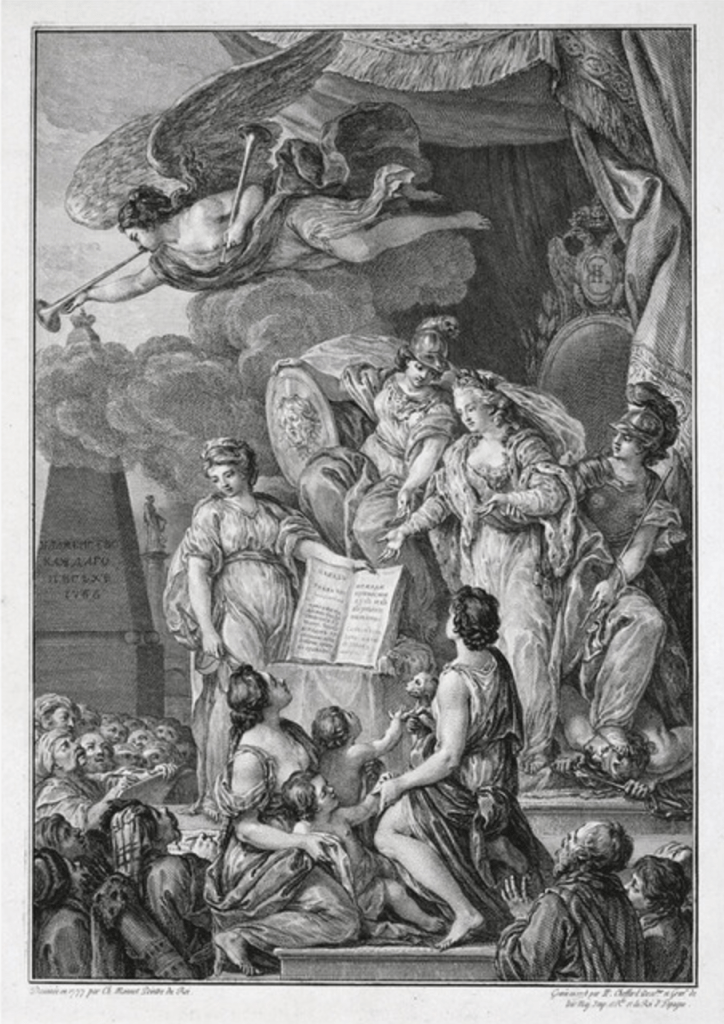
Allegory of the Empress Catherine II with the Text of Nakaz, by Charles Monnet and Pierre-Philippe Choffard (1778)
SEX AS SPECTACLE: THE COURT AS AN EROTIC BATTLEFIELD
Reviewers were quick to register the sheer volume of sex and bodily excess in The Great. By season three, this aesthetic has solidified itself as a default style, sex functions as both spectacle and punctuation: court entertainments, transactional hook-ups, marital coercion, and the occasional tender scene.
Importantly, these scenes are rarely just about desire. They are about hierarchy. Peter’s casual cruelty is often sexualised: his affairs with court women, his expectation that bodies exist to amuse him, and perhaps most absurd, his sexual encounter with Catherine’s mother which culminates with her falling from a window, all instances signal his “abominable, and intransigent charisma”.16 Catherine’s own sexual life is politicised from the moment Leo is assigned to her for happiness; intimacy is never private, always another way which the state intrudes.
On one level, The Great simply obeys the logic of contemporary television: those in the industry want a “strong personal narrative” and “iconic” figures through whom viewers can access big historical processes.17 Tristram Hunt notes that much modern history programming has drifted towards what he calls a Carlylian parade of “Great Men” (or women), where complex structures are reduced to the “travails of the individual” and their relationships.18 In these environments, producers are under pressure to deliver rating-friendly content. Sex fits neatly into that economy; it offers emotional stakes, clear heroes and villains in intimate scenarios, and a more digestible intensity between characters than in political meetings or reform votes.
Historical media is not immune to this format. Toplin observes that TV docudramas tend to focus on personalities and treat “almost all historical issues in terms of the struggles of specific individuals”, giving “relatively little exposure to ideas or to the broad impersonal forces” that historians would consider essential.19 The Great simply pushes this tendency to its limit: Catherine’s struggles are sexual as much as political, and the broader political issues retreat to the background.
Eighteenth-century observers could not agree whether the Empress was, a woman undone by a “traditional feminine weakness”, as in the German novel Pansalvin, which presents her fictional alter ego’s only major fault as letting the Prince of Darkness (Potemkin) have too much power.20 Or a cold, self-controlled ruler who used men as tools and discarded them “as we do with an orange, after sucking out the juice.”21
Meehan-Waters rightly notes that such accounts often reveal more about male anxieties than about Catherine herself.22 When critics depict her as enslaved by sensuality, female rule is condemned by the presumed feminine weakness to fall under the influence of male lovers. The Great sidesteps this by making its Catherine emotionally modern. She is an active participation in her romantic attachments and sexual endeavours, but is rarely seen as either a helpless victim of passion or a monstrous user of men. Her relationships with Peter, Leo and other lovers are scripted around growing mutual affection. This is in many ways a welcome rewrite. It refuses to replay earlier misogynistic tropes of Catherine’s early biographers. In the show, Catherine is both able to enjoy sex and rule, not having to forfeit one for the other.
THE FATAL COUP AND THE CURTAIN CALL: PETER III’S DEATH AND THE GREAT‘S END
Peter III’s brief reign (January 1762 – July 1762) ended in a coup that haunted every retelling of Catherine II’s ascent. Within two weeks of the coup, the tsar died under circumstances that were widely reported as natural, yet the language of the reports was deliberately ambiguous. The Gentlemen’s Magazine of 1762 recorded that Peter III died “of hemorrhoidal colic”23. This allowed the court to present the death as natural while keeping the door open for speculation about foul play.
The first wave of foreign commentary already treated the death as politically charged. German poet Anna Luise Karsch wrote to her friend Gleim that an informal biography of the new Empress was circulating, likening Catherine to the Roman Livia and Mary Stuart, and insisting that “the tsarina deserves to be eternally loathed if she had the slightest part in the plot against her husband”24.
As a fan of the show, despite Hoult’s portrayal of a lovable if not flawed Peter III, it became clear that the show could not continue if Peter did not meet his overdue end. His survival would have kept the series locked in the dynamic of “Russia’s most dysfunctional couple”, as one reviewer puts it, with Catherine forever navigating rule in the midst of his chaos.25 In that sense, The Great loosely follows the logic of eighteenth-century discourse around the coup, which depicted Peter as a deficient and weak ruler, emasculating him. At the same time, this discourse subtly masculinised the historical Catherine; for them, if the married duo were to go head-to-head in a masculinity contest, Catherine would come out on top.
The Great follows this pattern. Rather than portraying Peter as simply contemptible, it makes him charismatic and accessible to an audience, turning his lack into comic self-awareness: what he lacks in leadership, he makes up for in abundance with humour and much of the show’s comic relief. Fictional Peter meets an ultimately fitting death, returning home to Catherine and their son Paul, when the ice beneath his horse breaks, sending him plunging into the lake below. In narrative terms, this is a far more visually satisfying exit than the historical alternative, where eighteenth-century diagnosis located his fatal weakness in a part of the body so closely linked to reproductive performance and masculinity; the series gives him a resolutely masculine death on horseback.
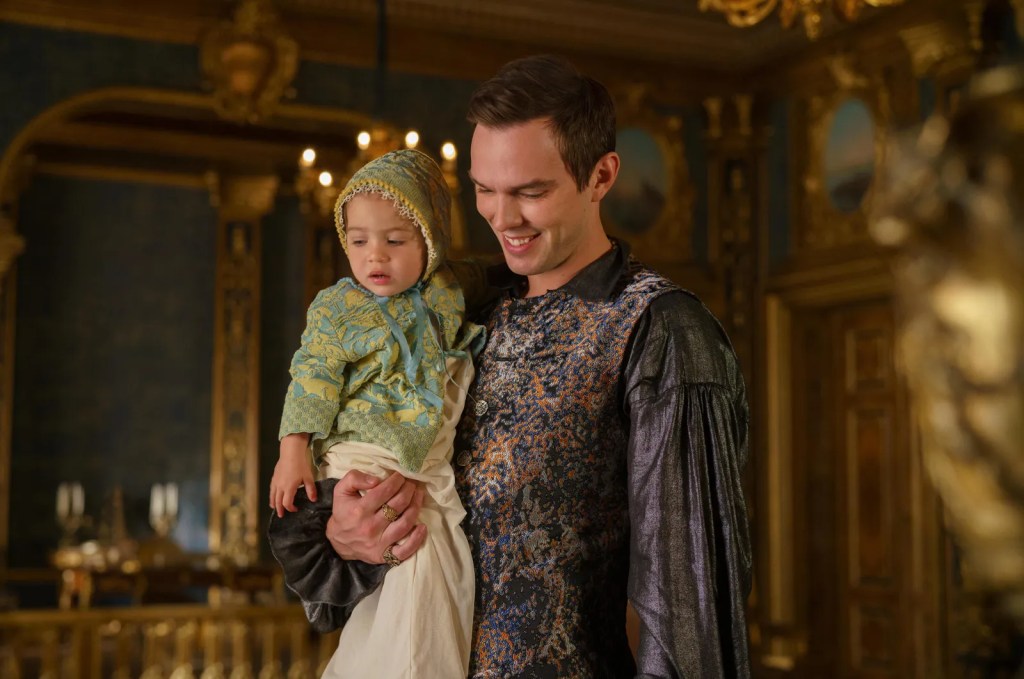
Nicholas Hoult as Peter, Season 3, The Great
At the same time, the show’s choice of an accidental fall through the ice carefully preserves the ambiguity that surrounded Peter’s historical end while keeping Catherine’s hands clean. By staging his death as neither a clear assassination (far from the attempt made by Catherine’s own hand in the season two finale) nor a purely natural collapse, The Great mirrors this eighteenth-century tension between courtly confirmation and salacious rumour.
Yet the narrative necessity of Peter’s death also marked the beginning of the end for The Great. Once Peter is gone and Catherine is firmly secured on the throne, the historical Catherine’s story becomes one largely dominated by legal codes, commissions, and charters, far from the dramatic coup and bedroom intrigue. Those are precisely the parts of her reign that television finds hardest to dramatise. The show’s eventual cancellation in August 2023 underlines how dependent it was on that original, ill-fated couple. In both historical fact and drama, Peter III’s exit is a pivotal moment, one that secures Catherine the throne, but also closes the most explosive and perhaps the most exploitable chapter of their story.
STREAMING ROYALTY: HOW THE GREAT FELL SHORT BUT STILL STOLE THE CROWN
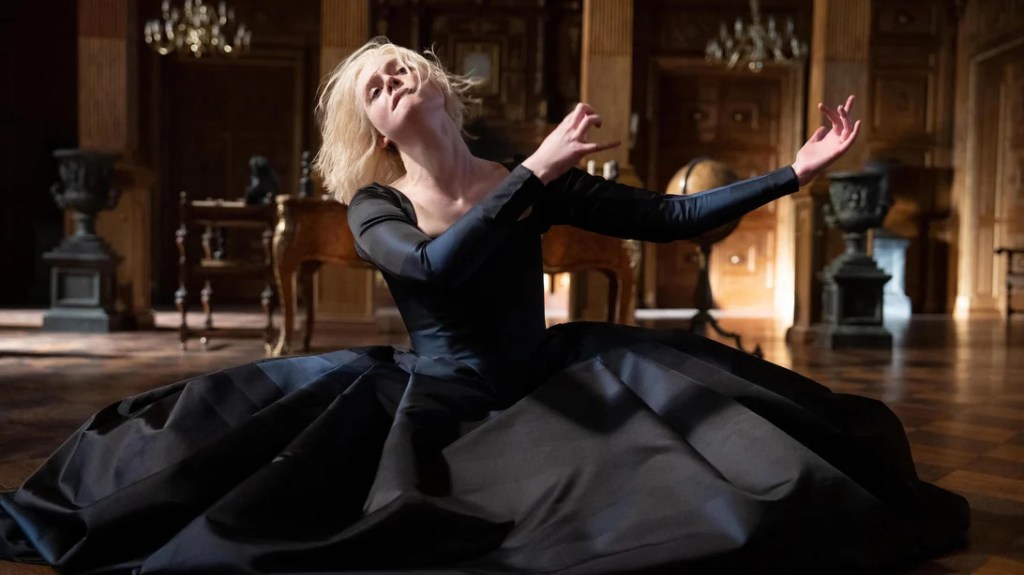
Elle Fanning as Catherine the Great, Season 3, The Great
The very premise of The Great, an occasionally true story, kept the series forever toeing the line between fact and fantasy. The result is a narrative that feels emotionally true and compelling but, at times, historically weak, a pattern that may have ultimately weakened its longevity. Upon Peter’s death, the metaphorical wheels of the show’s engine fell away as the high-stakes personal conflict between the pair fizzled, echoing the historical fact that Catherine’s most compelling moments, such as her coup and its aftermath, were the most sensational to contemporaries.
Despite this, the series succeeded in something many others struggle to do. It made an eighteenth-century Empress feel immediate, flawed and impossibly human. Elle Fanning’s Catherine was never a distant historical icon; she was a woman who fought, lusted, loved and occasionally discarded entrenched laws with a flourish of a pen. The show’s audacious and at times frankly nauseating style, its relentless humour, and its willingness to let a flawed Peter III become a tragi-comic hero made the Russian court feel alive in a way that academic prose rarely does. As a viewer and avid fan of the show since it’s debut in 2020, it’s impact going so far as to influence the topic of my A-Level History coursework about Catherine and the extent to which she was truly “Great”, the cancellation felt like the closing call of an audacious play, one that knew it was only occasionally true but still managed to capture the imagination of streaming audiences.
In the end, The Great reminds us that historical fiction can be both a conduit for those historically curious and a source of misinformation. But if I’m being truthful, I would imagine that most viewers realised the show would not be particularly historically informative from the outset. The show’s legacy lies not in its accuracy, but in the ways it sparked conversation about a leader whose real achievements remain far more intricate than any sitcom-style show could ever convey. For that reason, even as we critique its liberties, of which there are many, we can acknowledge the series for opening the door to Catherine the Great’s world and, in doing so, ensuring that the story of her reign continues to be revisited and, most important reimagined.
RECOMMENDED
Robert K. Massie, Catherine the Great: Portrait of a Woman
HBO/SKY TV, Catherine The Great
The Scarlett Empress, (1934)
Empire: World History, Catherine the Great: The Golden Age
footnotes
1. Adrian Horton, “The Great review – gleefully garish new series from The Favourite writer”, The Guardian, 13 May 2020, https://www.theguardian.com/tv-and-radio/2020/may/13/the-great-review-hulu-elle-fanning (accessed 21 January 2026).
2. IBID
3. IBID
4. IBID
5. IBID
6. IBID
7. IBID
8. James Harris, Diaries and Correspondence of James Harris, First Earl of Malmesbury (2nd ed., 4 vols., London, 1845), vol. 1, (p. 146.)
9. IBID (p. 146)
10. IBID (p. 146)
11. Nick Hilton, “The Great season three review: History at its most horrible – and enjoyable”, The Independent, 13 July 2023, https://www.independent.co.uk/arts-entertainment/tv/reviews/the-great-elle-fanning-nicholas-hoult-b2371266.html (accessed 23 January 2026).
12. The Great, Season 3, Episode 2 (Hulu, 2023).
13. Ruth P. Dawson, ‘Perilous Royal Biography: Representations of Catherine II Immediately after Her Seizure of the Throne’, Biography, 27.3 (Summer 2004), 517–33 (p. 520).
14. IBID (p.521)
15. Catherine II, second manifesto (1762), quoted in Ruth Dawson, ‘Perilous Royal Biography: Representations of Catherine II Immediately after Her Seizure of the Throne’, Biography, 27.3 (Summer 2004), 517–34 (p. 526)
16. Nick Hilton, “The Great season three review: History at its most horrible – and enjoyable”, The Independent (13 July 2023), https://www.independent.co.uk/arts-entertainment/tv/reviews/the-great-elle-fanning-nicholas-hoult-b2371266.html (accessed 23 January 2026).
17. Tristram Hunt, ‘Reality, Identity and Empathy: The Changing Face of Social History Television’, Journal of Social History, 3 (Spring 2006), p. 848
18. IBID (p. 844)
19. Robert Brent Toplin, “History on Television: A Growing Industry”, The Journal of American History 83, no. 2 (December 1996), 1109‑1115, 1111‑1112.
20. J. E. F. Albrecht, Pansaloin, Fürst der Finsterniss und seine Geliebte (Germanien, 1794), p. 406.
21. James Harris, 1st Earl of Malmesbury, Diaries and Correspondence of James Harris, First Earl of Malmesbury (2nd ed., 4 vols, London, 1845), vol. 1, (p. 146)
22. Meehan‑Waters, Brenda, “Catherine the Great and the Problem of Female Rule”, The Russian Review 34, no. 3 (July 1975), (p. 300)
23. The Gentleman’s Magazine, July 1762, (p. 438)
24. Anna Luise Karsch, letter to Gleim (1762), reproduced in Denkwürdige Lebens‑ und Staats‑Geschichte des russischen Kaisers Peter des Dritten (Danzig, 1762).
25. Nick Hilton, “The Great season three review: History at its most horrible – and enjoyable”, The Independent, 13 July 2023, https://www.independent.co.uk/arts-entertainment/tv/reviews/the-great-elle-fanning-nicholas-hoult-b2371266.html (accessed 23 January 2026).
BIBLIOGRAPHY
Albrecht, J. E. F., Pansaloin, Fürst der Finsterniss und seine Geliebte (Germanien, 1794)
Dawson, Ruth P., ‘Perilous Royal Biography: Representations of Catherine II Immediately after Her Seizure of the Throne’, Biography 27.3 (Summer 2004)
Harris, James, First Earl of Malmesbury, Diaries and Correspondence of James Harris, First Earl of Malmesbury (2nd ed., 4 vols., London, 1845), vol. 1.
Hilton, Nick, “The Great season three review: History at its most horrible – and enjoyable”, The Independent (13 July 2023), https://www.independent.co.uk/arts-entertainment/tv/reviews/the-great-elle-fanning-nicholas-hoult-b2371266.html
Horton, Adrian, “The Great review – gleefully garish new series from The Favourite writer”, The Guardian, 13 May 2020, https://www.theguardian.com/tv-and-radio/2020/may/13/the-great-review-hulu-elle-fanning
Hunt, Tristram, ‘Reality, Identity and Empathy: The Changing Face of Social History Television’, Journal of Social History 3 (Spring 2006)
Karsch, Anna Luise, letter to Gleim (1762), reproduced in Denkwürdige Lebens‑ und Staats‑Geschichte des russischen Kaisers Peter des Dritten (Danzig, 1762)
Meehan‑Waters, Brenda, ‘Catherine the Great and the Problem of Female Rule’, The Russian Review 34.3 (1975)
“The Great”, season 3, episode 2 (Hulu, 2023).
Gentleman’s Magazine, July 1762.
Toplin, Robert Brent, “History on Television: A Growing Industry”, The Journal of American History 83, no. 2 (December 1996), 1109–1115, 1111–1112.
 The Reel vs The Real
Leave a comment