“FUCK THAT”: THE SHOW’S PREMISE IN ITS OWN WORDS
Amazon Prime’s My Lady Jane (2024) announces its intentions within its first thirty seconds. The narrator tells the audience that Jane “could have been the leader England needed”, but “history remembers her as the ultimate damsel in distress”, before the camera cuts and he adds: “Fuck that. What if history were different?”.1
What follows is an eight episode fantasy show adapted from the young adult Lady Janies novels, in which Jane (Emily Bader) is reimagined as an intelligent herbalist, staunch in her opposition to arranged marriage. Whilst these two things are feasible what is not is the version of Tudor England she inhabits. The plot traded the religious contention of the period, and instead created an oppressed minority called Ethians who can shape shift into animals. It is abundantly clear that the show is not historically accurate. The question this blog instead asks is whether this reimagining actually serves Jane, or whether it replaces one myth with another.

Emily Bader (Lady Jane Grey) in My Lady Jane | Photo Credit: Jonathan Prime/Prime Video | © Amazon Content Services LLC
PAWN, SCHOLAR AND PROTESTANT: THE REAL LADY JANE
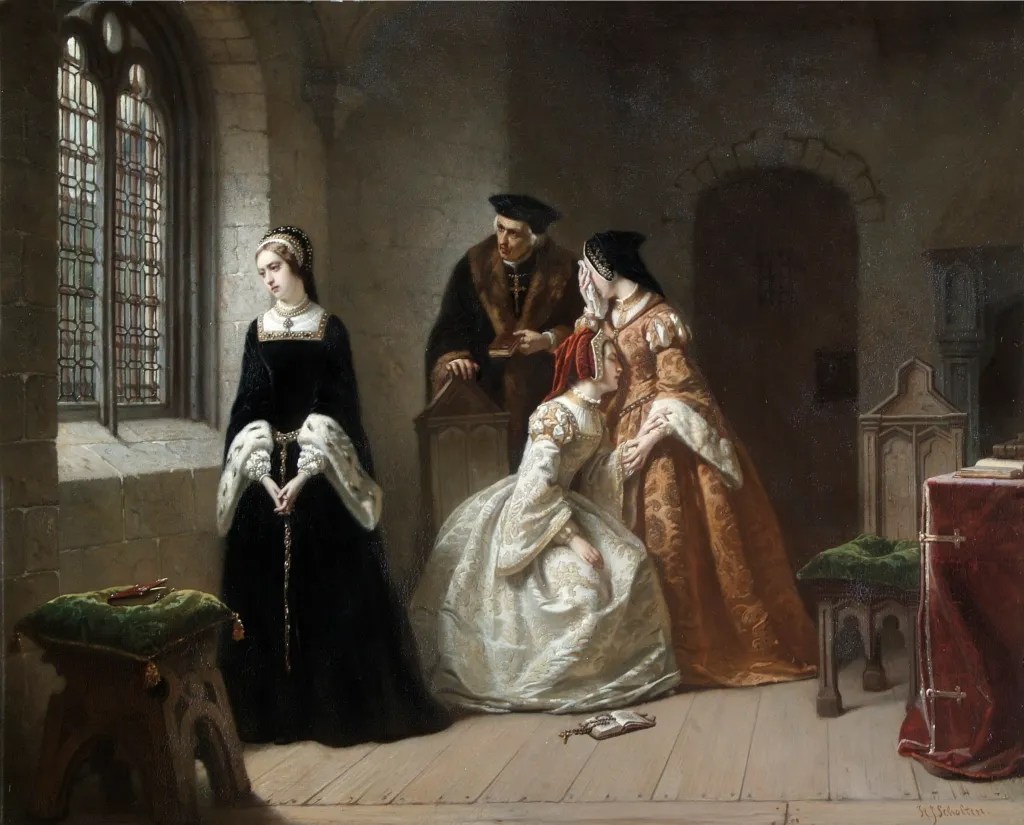
The historical Jane Grey was the great granddaughter of Henry VII thrust on the throne in July 1553 at sixteen by the deathbed succession wish list of the boy king Edward VI and the political manoeuvring of Jane’s father-in-law, the Duke of Northumberland. Her reign lasted only nine days, after which she was deposed by Edward VI’s eldest half-sister Mary, who imprisoned Jane, convicted her of treason and executed her in February 1554.
What kind of person was she? The documentary record is thinner than popular interest in Jane suggests. Subsequently, the image we have is largely a construction, Jane as an innocent Protestant martyr and victim of a ruthless, Catholic Mary. What contemporary sources do agree on however, is that Jane was an avid learner. Humanist tutor Roger Ascham, found thirteen-year-old Jane reading Plato’s Phaedo in Greek in her chamber, while the rest of her family was out hunting. Jane reportedly told him that their sport was “but a shadow” when compared to the true pleasure of reading Plato.2
Not only was the real Jane bookish, she was also not passive. Historian Nicola Tallis, author of Crown of Blood (2016), argues that whilst what we know about Jane may be limited it is known that “she was incredibly strong minded”, and in her interview with the BBC, Tallis argues that the show is not a disservice to the memory of Jane but instead serves as a celebration of her voice which has been largely sidelined. Her strong mind is perhaps best shown in her decision to remain a fierce Protestant despite being offered a pardon by her cousin Mary, unwilling to accept the restoration of the Catholic faith across England.
Victorian fascination with the Tudor’s helped to complete the myth of Lady Jane. Paul Delaroche’s 1833 painting The Execution of Lady Jane Grey, which remains one of the most popular works in the National Gallery, fixed her as a symbol of innocence and martyrdom. By the time that My Lady Jane’s narrator says fuck that, he is contesting the myth of Jane carefully constructed across centuries, one which paints her as a passive, saintly martyr.
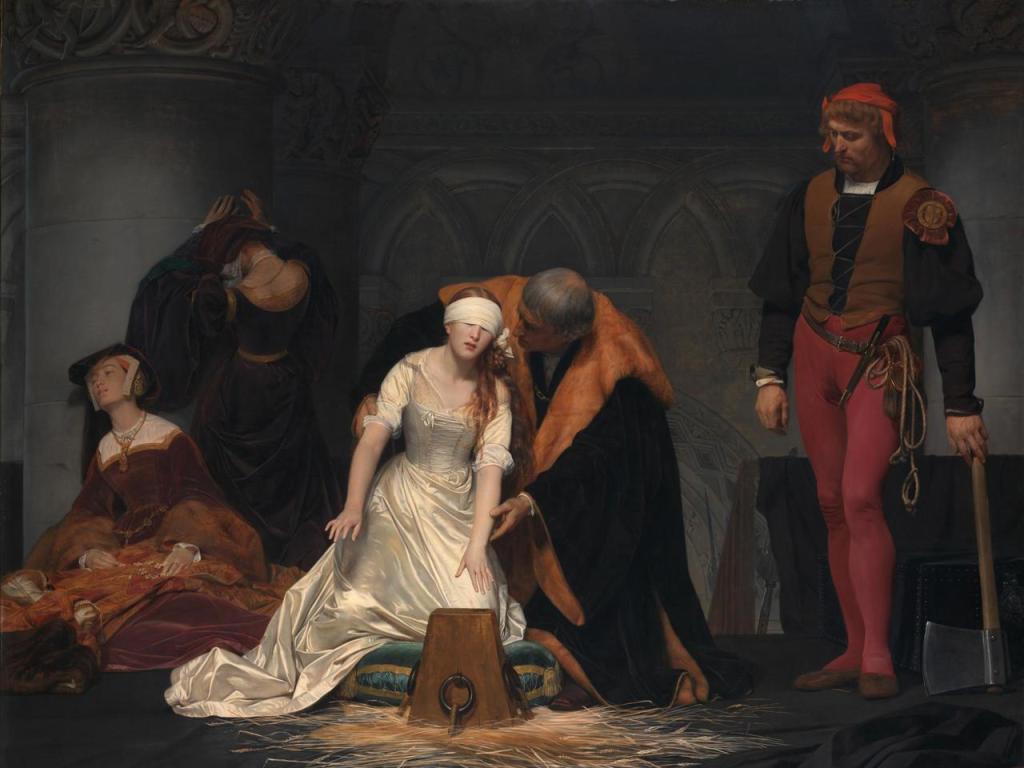
The Execution of Lady Jane Grey. 1833, oil on canvas, 246 × 297 cm. The National Gallery, London.
THE GIRLBOSS PROBLEM: RELIGION OUT, SASS IN
The most significant thing My Lady Jane removes from Jane’s life is the thing that defined it. John Reeks states that “religion exists in this world, but only as window dressing”, playing no role in influencing any of its characters. Jane’s talent thus shifts from religion and ancient languages to herbalism and medicine. Emily Bader herself acknowledges this trade off, stating how this shift deliberately gives Jane “more agency than she ever possessed in real life”.
Critics were quick to name this formula. Slate slots this show into a genre of ‘Sassy Queens’ alongside Reign, The Great and Dickinson, confessing weariness with a “heroine who is both anachronistically audacious and way too girlboss-y”. This portrayal of historical woman has in itself become a prevalent archetype, therefore the only irony of this show is that in rebelling against the passive martyr, My Lady Jane conforms to one of the most modern conventional archetypes on television.
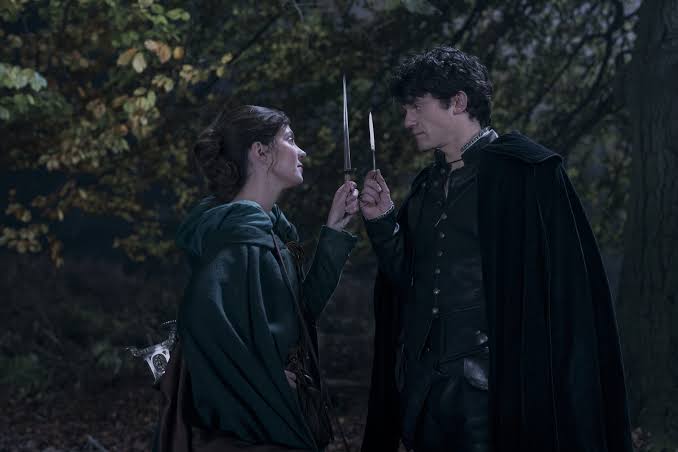
Emily Bader (Lady Jane Grey), Edward Bluemel (Lord Guildford Dudley) in My Lady Jane | Photo Credit: Jonathan Prime/Prime Video | © Amazon Content Services LLC
ARE WE MAKING HISTORICAL WOMEN TOO MODERN?
What I believe My Lady Jane does well is it maintains her defiance. Granted it does so by stripping her of her Protestantism, replacing it with a more civil cause. Jane’s stubbornness is redirected towards the rights of the Ethians, a condition which her husband Guildford Dudley is afflicited. In this way, the show understands Jane far more than what may be first believed, she is defined by her own moral code, just as real Jane was defined by a religious one. This representation of Jane, as a young woman who fights back against her mother, talks out of turn to those who outrank her and how she holds her nerve under pressure is closer to the “incredibly strong minded” Jane, far from the victim that she has popularly been portrayed as.
On a personal note, I thoroughly enjoyed this show despite its historical inaccuracies, just as I enjoyed Tony McNamara’s The Great. Bader and Edward Bluemel’s chemistry carries even the show’s silliest plot lines. It matters, too, that the show’s Jane is willing and nearly dies for her convictions, facing execution for the Ethian cause and for her marriage to Guildford. Whilst Bader’s Jane is saved from her execution and rides off into the night on the back of her husband, in his Ethian horse form, the real Lady Jane was not so lucky, and that is the crux of the problem. Whilst Jane’s convictions and willingness to die survives, her reason for being sent to the scaffold does not. Fictional Jane is allowed to flee her scaffold because the show had already given her a different life; the real Jane’s story ends because her convictions gave her no feasible exit.
My Lady Jane swaps the damsel for the girl boss, one myth for another. In maintaining her intellect and convictions the show serves her well, but it does so by replacing her religious faith with fiction, a trope becoming increasingly prevalent in this new age of historical media.
FOOTNOTES
- ‘Who’ll Be the Next in Line?’, My Lady Jane, season 1, episode 1, written by Gemma Burgess, dir. Jamie Babbit, Amazon Prime Video, 27 June 2024.
- Roger Ascham, The Scholemaster (London: John Daye, 1570).


Leave a Reply